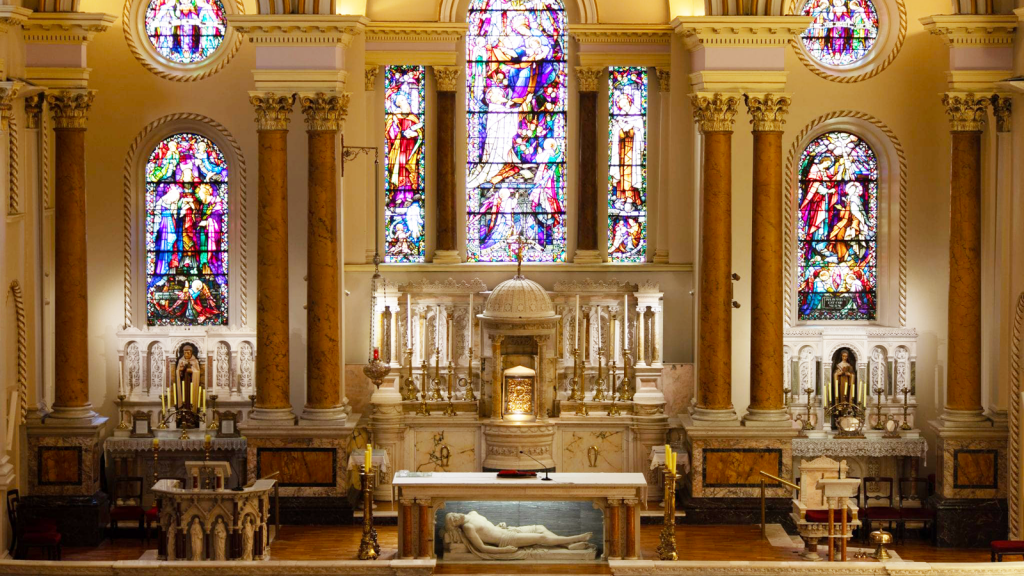
I am sitting in the back of St. Teresa’s Church on Clarendon Street, next to my dear friend Donncha and his little one, Michael. It is dull mid-November and it is already night. We are there for a healing meeting at a Charismatic Catholic group called Living Water. I am weary, and desperately in need of healing in my soul. Before me, adorning the altar, as if spilling out of a tomb is a white marble statue of the broken body of Christ. It is a strangely beautiful and radiant image of a gruesome moment. The Adoration service is nearly over, and suddenly I encounter the real presence of Jesus, represented by the communion wafer visible in the gilt monstrance standing atop the altar, like a cruciform starburst. This is why I came, and at last, He speaks to my hurting heart.
I have come with fresh and bleeding wounds, and some newly healed with bright pink scars. I won’t elaborate any details, but despite the wholly positive and wonderful memories and experiences I had in Dublin, there is a common thread in the moments where I experienced the most pain over the years.
Throughout my life, at times, the defining characteristic of Leslie—her quiet thoughtfulness and hesitation to speak, her soft voice and gentle nature—were at times highlighted as rendering me insufficient, as if something was wrong with me. I have always been desperate to serve God to the utmost of my ability, and this, combined with my obliging and gentle nature, was easily exploited. I didn’t even realize until recently that I have a long history of being taken advantage of and even bullied—my unique spirit trampled, and boundaries disregarded. Even worse was that I had slowly become a people pleaser while serving in Ireland.
I had two major heartbreaks in the past two years; one was a relationship I was sure was destined to culminate in a marriage, and the other was an abrupt ending to my café job. The varying levels of emotional abuse and bullying I endured were confusing and painful, and both ended in loss and grief. It echoed some of my experiences of serving in Irish churches, which, unfortunately, is inevitable. Christians sometimes do things which can be unspeakably cruel or cold. Church hurt is the absolute worst.
I pondered this pain on that evening in St. Teresa’s, sitting in the warmly lit silence, bathed in candlelight and streaming winter streetlights through the back windows. I will admit that since that heartbreak in early 2020, which I endured near complete isolation during lockdown, I had trouble praying. One day in particular I cried and cried on my back, shrieking silently, asking Jesus why. I never felt a calming or comforting presence there with me as my heart was rent from my body, and all my dreams died.
For a while I wondered why I even followed Jesus, and during a dark period that summer I wondered whether I was about to lose my faith. It was unconscionable to me, yet I was living in that uncomfortable reality. It was well over six months before I was able to cry again, because the previous times when I cried without comfort, it brought such physical pain that my body refused to allow it. I don’t even remember how long it was before I was able to mutter prayers of just a handful of words. It must have been closer to a year. All the while, even when I could not pray, I missed the pure, simple presence of Jesus that I always encountered during monthly Adoration services with my Catholic friends. I felt so alienated from God, but I knew I needed Him.
These experiences left me feeling unwanted, unappreciated, unseen, like my work and my love had been fruitless; defeated. So when Jesus finally spoke to me in the warmth of St. Teresa’s, everything made sense, and I felt Him near me in a way I hadn’t for many long months. I asked Him why, and He showed me His body, which had been stretched out before me the entire hour. Suddenly I saw my own rejection and misunderstanding and abuse contextualized through His own.
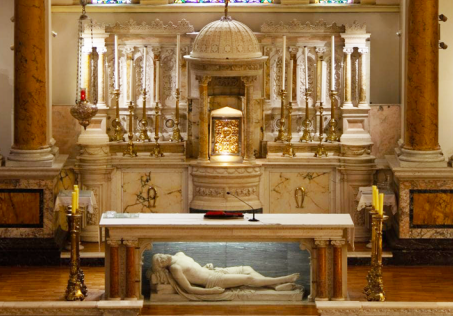
He said that His wounds were for my benefit, for the benefit of many, for the world. My wounds had no meaning or context in isolation, only regarding my own life. Our pain is meaningless if it is kept hidden and in isolation. But when bared bravely, our painful wounds can be exactly that by which someone else is healed, for by His wounds we are healed.
As I look back on these experiences, I see moments in which I wish someone could have stood up for me, to refute the injustice of the situation. I am proud to say that all along the way I stood up for myself, but I had a lot to learn about my threshold for tolerating poor treatment. I also could not have foreseen that these heartbreaks would actually begin to shape and feed into my academic research on fasting, suffering, and compassion, and above all, to fuel me with a greater purpose for becoming a scholar. Now I will not be silent when I see injustice and oppression, and it starts with my ability to choose what I will and will not tolerate for myself.
Philippians 2:3-4 talks about how we should consider one another better than ourselves, and that we should not pursue our own selfish ambitions, but to consider the welfare of the other above our own: this is healthy humility and servanthood. This ideal does not work if it is not reciprocal, which is an extremely simplified way to define abuse.
All of this is to say that I have shied away from making strong statements in the past, but my real experiences of being exploited or abused when I was most vulnerable have kindled a flame within me. I have been an immigrant with no built-in community to fall back on. I have been in the hospitality industry, living without any savings since 2017. I have experienced emotional abuse such as manipulation, coercive control, and gaslighting by a romantic partner—someone I met in church! I have been a woman not taken seriously by peers or superiors both in church contexts and academic contexts, despite my education, training, and experience in those field—intensely frustrating.
Leslie has always been quiet. The volume level of my physical voice will not change, but I believe it is time for me to step forward and begin to raise my voice. My goal is not to condemn anyone, but to cry out for increased compassion toward others, rather than hardened hearts. This can only come if we have self-compassion for our brokenness, for we will begin to see it in everyone we meet, if we are truly discerning—even the most despicable among us. This is the only way for the light to shine through the cracks.
Please, do not let your pain be meaningless. It will not be transformed and until we choose healing, when we are ready. That image of Christ’s dead body is stark, but unyielding in its representation of His very real suffering. When we choose to bare our wounds, it does not make them hurt any less. It does not shorten the duration of the pain; it does not magically erase the heartbreak. I hoped my healing encounter that night in November would make it all evaporate from my heart, mind, and body. Instead, it lessened the burden, because I knew I was not suffering alone, or pointlessly.
As I look forward to a new chapter, it is my hope and prayer that I can use my own God-given Leslie voice to speak loudly on behalf of those vulnerable, underprivileged, and often silent. I may step on a few toes, but it is worth it if I can amplify the voice of someone else who has long been hesitant or afraid to speak. The ones who have been quiet the longest often have the deepest and most beautiful things to say. Listen to us.
This little blog of mine doesn’t reach many people, but I want to publicly mark this moment, here in the earliest hours of my 32nd birthday, as a step forward into the light. I have been waiting to “speak” until I felt I had something of value to say, and I know now I have a message that I know will carry me forward, both as a missionary and as a female scholar in biblical studies.
Sometimes I still wonder why I had to endure such awful things, but now I understand that I can channel it toward loving others, administering healing and compassion, and founding friendships that will change lives and communities, one moment and one soul at a time. This has always been my loudest prayer, and it is humbling to know that Jesus chooses to use me in this way.
 Leslie Flores
2 responses to “A Brief Theology of Suffering”
[…] A Brief Theology of Suffering […]
Thank you for these beautiful words you shared. God has a great plan for you Sister Leslie.