The first career I remember dreaming about as a kid was becoming a scientist (thank you, Bill Nye). I also wanted to become an artist, because I loved painting and drawing.
I remember when we moved to Soap Lake, Washington, a woman at my new elementary school asked me what I wanted to be when I grew up, and I told her either a scientist or an artist. I won’t forget the confused look on her face, as if those two things were opposites, and that it was a ridiculous dream.
But when we ask kids that question, what we’re really trying to find out is who they are, just as much as they are learning who they truly are. I remember feeling disheartened by her response, because she was, in essence, by dismissing my dreams, dismissing me.
Sometimes life’s path can seem a little meandering; in community college I was led by my artistic impulses to take ceramics classes for a year. I absolutely loved it, even though I was no good. Little did I know that in my thirties, I would come to find my artistic inclination come to meld deliciously with my love of science in archaeology. Looks like that pottery class wasn’t inconsequential, after all!
I’m still a budding Indiana Jones in some ways, but knowing terminology and the tactile reality of making pottery has been such an advantage as I have begun to explore archaeology in the ancient Levant.
Based simply upon how the pottery is formed, how it is finished (burnished, glazed, painted, left plain…) we can tell where it was made, which shows us that if it has traveled far, due to trade in the region; approximately when it was made, based not only on the development of the style or techniques, but how the movement of peoples and their pottery styles influenced the changes to the pottery in the area; and through petrography and minerology, from where exactly the clay was taken, within 200 meters squared! There is so much information we can gather from such a commonplace object. There are even some archaeologists that think they can discern what type of society ancient Israel was–conjectured to be egalitarian and embracing simplicity, versus materialistic–based upon the unadorned nature of their pottery.

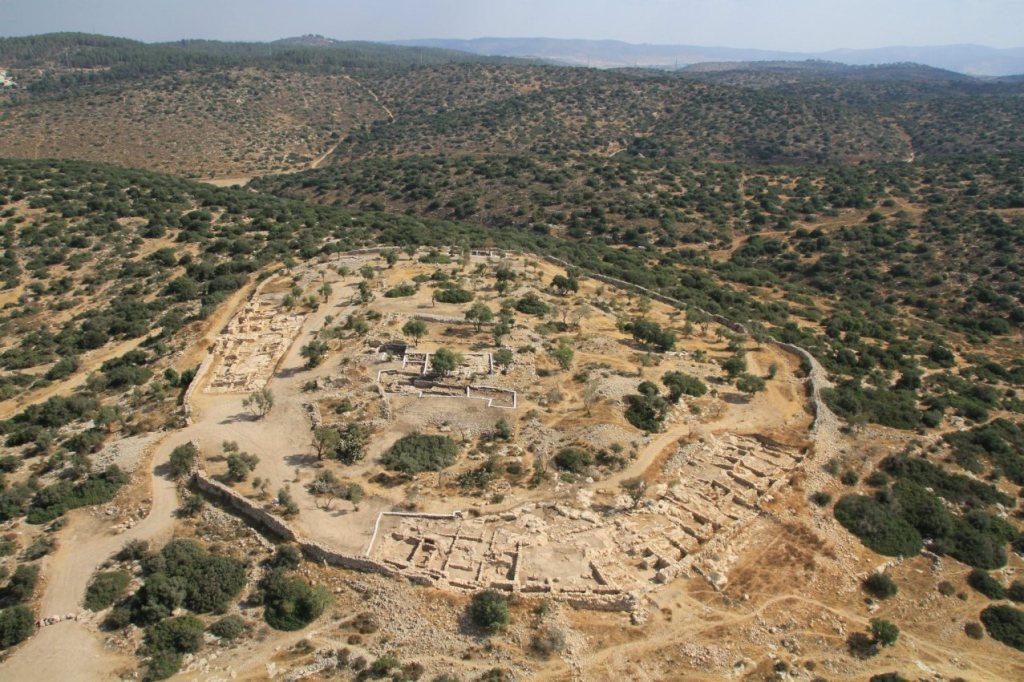
In an archaeological dig, much of the work is done on what are called tels. It is a specific word for the manmade hills upon which ancient Levantine settlements were built, layer by layer. So each site has a tel named after it, sometimes similar to what we have in the bible, and sometimes with a different name.
The way we extract information about these ancient settlements is to dig through them layer by layer in order to uncover the artifacts that could be there in the soil, and this reading of the data is called stratigraphy. Even the soil itself is extremely useful in providing information about how the soil got there. For instance, if there is ash, did something burn, or did the ash gather there, blown by the wind? It can also give us information about the type of vegetation which flourished in that era, and therefore the climate at the time, thereby helping us understand fluctuations in population and movements of peoples.

This knowledge, then, should give us a deeper understanding of what it means in Isaiah 61:4 when the prophet says that Israel will one day build the ancient ruins, and repair the “devastations of many generations.” One devastation after the other, these strata were built up into an increasingly higher “city on a hill.” At times the tels lay uninhabited for hundreds (or even thousands) of years, until they were inhabited again at a later period in time, and people simply rebuilt: sometimes smaller settlements, and sometimes larger, but always atop the old foundation.
Everything we can glean from a particular stratum usually shows commonalities along strata from around the same date, in the wider region. These established cultural traits are called the archaeological horizon. It reflects a reality that once existed, that once thrived, that has been destroyed and gone for thousands of years, but that still speaks to us about what once was real. And just as physically these layers provide the foundation for the next stratum, it is the same with technological advances: from the Bronze Age until now, we build a new present on previous realities.
I feel that since last year, I went through a devastation phase–again. In some ways the personal devastation wrought by the pandemic feels strangely familiar, reflecting the many times I have moved in my life. Each time I move I have to rebuild myself, in a way. I have to reintroduce myself, I have to reestablish myself in who I am, and build from the resources I have around me. Sometimes those resources have been extremely scant, and in other places, like here in Dublin, they have tended to be plentiful and rich.
I know that while I was in the US for those unexpected five months this year, I transformed. I developed tremendously as a scholar because I did nothing but read and study. But also I made conscious and continuous choices to heal from the traumatic experiences I had in 2020. I rebuilt myself from the ground up. I am still the same Leslie, but just in a new phase.
Therefore, returning to Ireland and even moving house a month ago has made me feel like I am again in a rebuilding period, post-devastation, with meagre resources. I still have the memories and even artifacts of the previous horizon: photos and gifts and mementos which remind me of my once busy social life, in which I was running in so many different social circles–academic, church ones, non church ones, work ones, etc.. Some of my friends are still in Dublin, many are not. I have changed churches. It’s different, and I feel a gentle, pervasive sense of grief that I associate with Dublin now.
All this to say that it is forcing me, in the lonesome moments, in these recent weeks when my energy levels are not what they used to be, to dig deep and reexamine my old horizons. What makes me who I am? What makes me feel like myself, when my same friends no longer surround me in their dozens? Where is my old self-sufficiency, when I had to entertain and sustain myself in seasons of loneliness?
All of these strata which make up an archaeological tel have one thing in common: they are called destruction layers, for all that remains are the foundations of what used to be there. Whatever grandiosity, whatever flourishing life was there, has vanished, but the base which held the settlements and grounded life is still there for us to examine, and to learn from.
When everything is swept away, and we no longer recognize our old lives, remember the foundation is still there. And remember that we can rebuild on our foundations, because they remain sure as ever. As we come out of this pandemic, whatever we rebuild from the devastation will be something completely new, but based on our same true selves.
Regardless of whether our old selves were “better” or more grand, my prayer for our world is that our new selves will be truer than before. Let us also remember that we cannot build something to last if it is not built on the solid foundation of who we were created to be in Him. And finally, let us have the courage to dig into our souls, to remember the previous horizons that brought us here, in order to expand into a new horizon.
 Leslie Flores